I was accused, recently, of being "the most organized person I know" by a friend of mine. (That accusation was quickly followed by, "That might reflect poorly on my friends," but still ...) As it turns out, judging, scorekeeping, and tournament organizing have contributed more than their fair share to my organizational habits.
When I first started scorekeeping side events at SCG Opens, I didn't write a lot down. I had a computer in front of me that had all of the information I needed in it ... somewhere. If someone asked me a question, I could flip through the DCI-R events or the event details pages and answer it. But, as it turns out, those things take time, and time isn't something scorekeepers have a ton of. I started making paper charts of important event information so I could answer those questions in two seconds instead of 10 or 15; better yet, someone walking by could just glance at them and find out what they needed to know. I've posted a couple of these before because I think they're fun event souvenirs, but here's another example from GP London:

(See all those smiley faces? They mean that event is finished. Which is good, seeing as how London was two months ago.)
There are many facets of organization. These charts are just one of them. The other, and the one I think is most important, is being prepared.
Even with all the skill and experience in the world, if you show up to an event with no idea of what's going on and without the tools you need, your success will suffer.
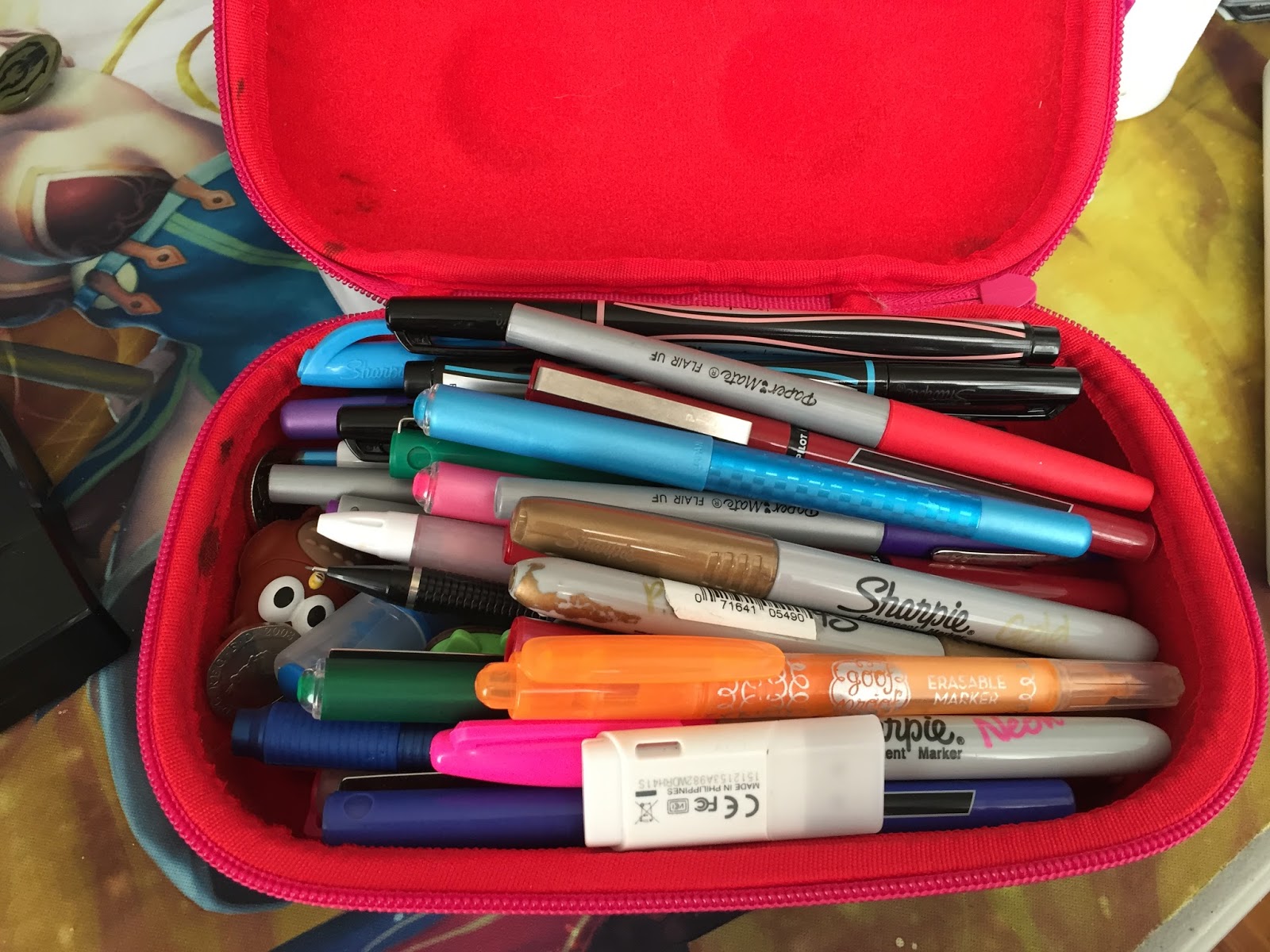
I have a pencil case that I take to events. In fact, I carry it pretty much everywhere I think I might want to do any sort of work. It looks like this:

Because, you know, I believe in fun.
1. Notebook
Everyone needs a notebook. Whether you're judging or on stage, having a place to write things down is super important. While a computer or smartphone can make a decent notebook, they have one huge downside: they need electricity. If your phone dies in the middle of the day, how are you going to write down the details of that sweet judge call you want to remember forever or the observation you made about the new judge's confidence?
My notebooks are also a record of the things I've accomplished and the things I still want to accomplish. They have notes from events, lists of posts I want to get around to writing, goals for judging and scorekeeping. It's a journal, but only for things related to Magic: the Gathering. I even have some pictures of sweet draft decks in there. This is one of the best tools that exists for reflection and improvement. Oh, and organization.
I like to use moleskine notebooks. They're expensive, but they hold up well to constant traveling and abuse. Plus, they come in a billion different colors, sizes and styles so I still get to have some fun with them. My current one is white. Well, it was white. It's gotten a little dirty.
2. Pens, Pencils, Highlighters, Sharpies
These take up most of the space in my pencil case. Surprising, right? I use pencil to fill in chart information that might change — starting table number and round, mostly. Highlighters are useful for processing drop sheets and prize payouts. Pens are for everything else.
I don't use sharpies much, but it's inevitable that I get asked for one at an event. Someone wants a card signed or a judge needs a bolder note on the pairings sheet. I always prefer to be the person that says "Yes, I can help you with that," so I bring a sharpie or two.
If you're judging, bring a red pen. Or pink. Or orange. Actually, anything that's not blue or black is just fine. Most players have blue and black pens, and anything that stands out on a match result slip is great. But please don't write on slips with sharpies. Especially not the back of slips. They bleed everywhere and make things hard to read.
3. Sticky Notes
There are a few things I'm miserable at remembering. Assigning fixed seats when I get registration files is probably the biggest one, so I write the player's name and table number on a sticky note and plant it firmly on my computer screen, usually somewhere where it's in the way. Sometimes it helps, and sometimes I get used to working around it and forget why it's there.
Sticky notes are also great for tagging lost and found items and passing notes. Most of the organizers I've worked with have these in their office supplies, but I always bring my own little ones.
4. Flash Drives
For the people on stage, the Internet is usually an essential tool. We use it to pass files around and communicate with staff on the other side of the hall. But, inevitably, something bad happens. Someone's laptop can't connect. We hit the maximum number of connections. It's too slow to sync files. A flash drive solves all of these problems.
I have an owl and a turtle. There's nothing like a small silver lining to a stressful situation, and absurd flash drives are amusing, right? I also have a grown-up flash drive for when I want people to think I'm a professional, but that's not very often.
5. USB Hub
Speaking of, I need to get a new one of these. My old one has outlived its functionality :(
Sometimes an organizer hands me a laptop, and sometimes I use my own. My laptop has three USB ports. I've been at many events where the admin laptops only had two. When you know you need to plug in a printer, a mouse and, often, a 10-key, two or three USB ports doesn't cut it, especially not when Internet access might use one and you might need to transfer files the old fashioned way.
6. Headphones
If there's any chance I'm interacting with players, my headphones stay in my pencil case. There are times when they're awesome, though, like catching up with paperwork as events are winding down, especially grinding through post-event entry of 8-man brackets, and on breaks. I use a hair tie or rubber band to keep them folded up nice and tidy.
7. Chargers
There's nothing quite like getting a quarter of the way through the day and realizing you don't have a phone, computer or tablet charger. Whoops. My computer charger doesn't fit neatly in my pencil case, but the other two do. Like headphones, I keep them wrapped up neatly with a hair tie. I also keep a backup computer charger in the backpack I travel with. I've never had to use it, but I'm glad it's there.
8. Change
This is one of the newest additions to my pencil case, mostly because I like Diet Coke WAY too much. Coins and $1 bills make it easier to acquire delicious beverages from vending machines. They also make it easier to make change for communal lunch orders and coffee/hot chocolate runs.
9. Advil
Advil is my headache-be-gone drug of choice. It's also awesome to have around when the venue chairs suck or I do something stupid to my shoulders or wrists while I'm working.
Many organizers can't provide ibuprofen or any other drugs to their staff or players, and working through pain is miserable. I've forgotten this a couple times, and all the other awesome registration and scorekeeping staff who don't forget have been responsible for my sanity at more than one event.
10. Tablet, Book or Other Entertainment
Taking breaks is important. I'm one of the worst offenders on this front — I enjoy scorekeeping, and I'd often rather keep doing it than go do something else, especially if exciting things are happening. I'm extra bad at taking breaks when I've been working on something with my downtime, like a blog post, review or event feedback.
Having something to do while on break makes leaving the stage and disconnecting from the event for a while more enticing.
What do you take to events? Whether you're judging, on stage or working in some other role, what things are essential to your event success?
(Edit: Thanks for the comments guys! They have to be approved before they appear to prevent spam, so if you don't see your comment right away it's because I haven't seen it yet.)

8. Change
This is one of the newest additions to my pencil case, mostly because I like Diet Coke WAY too much. Coins and $1 bills make it easier to acquire delicious beverages from vending machines. They also make it easier to make change for communal lunch orders and coffee/hot chocolate runs.
9. Advil
Advil is my headache-be-gone drug of choice. It's also awesome to have around when the venue chairs suck or I do something stupid to my shoulders or wrists while I'm working.
Many organizers can't provide ibuprofen or any other drugs to their staff or players, and working through pain is miserable. I've forgotten this a couple times, and all the other awesome registration and scorekeeping staff who don't forget have been responsible for my sanity at more than one event.
10. Tablet, Book or Other Entertainment
Taking breaks is important. I'm one of the worst offenders on this front — I enjoy scorekeeping, and I'd often rather keep doing it than go do something else, especially if exciting things are happening. I'm extra bad at taking breaks when I've been working on something with my downtime, like a blog post, review or event feedback.
Having something to do while on break makes leaving the stage and disconnecting from the event for a while more enticing.
What do you take to events? Whether you're judging, on stage or working in some other role, what things are essential to your event success?
(Edit: Thanks for the comments guys! They have to be approved before they appear to prevent spam, so if you don't see your comment right away it's because I haven't seen it yet.)