Showing posts with label preparation. Show all posts

Wednesday, March 16, 2016

GP DC 2016: Getting Started

At around this time last week, I was looking forward to venturing a few hours north for GP DC. It was shaping up to be pretty big, even as far as GPs go. From my comfy seat in the present (which is a couch at a friend's house), it turned out to be exactly that: more than 3.000 players teamed up with their friends to wade into Battle for Zendikar Sealed.

Somehow, I have a habit of finding myself at giant events, which works out: they're way more interesting than smaller events.

The Challenges were my domain over the weekend: along with Meg Stephens, I was on Swiss sides scorekeeping. As was the case in Philly a few weeks ago, we were doing this in WLTR (except for the Two-Headed Giant events, which you'll hear more about later - a lot more).

Meg is fantastic, so I was prepared for this weekend to be relatively easy despite the player count. We had a spot on the side of the Customer Service stage with one seat facing front and one seat facing the side. This gave us enough spaces for laptops, printers, notes and elbows. Meg took the front of the stage on Friday and Saturday, and I took the front on Sunday (because there are only so many times you can tell players that their slip also goes in the box before you go crazy).

Splitting Events

Because no one gets byes in Team Sealed GPs, there weren't any grinders to run. Star City Games filled that spot on the Friday schedule with flights of Team Sealed events and Team Sealed Spectaculars for prize wall tickets. Those events were run from the GP stage, as was the Two-Headed Giant event.

Additionally, the Super Sunday Series events and IQs on Sunday were run from their own mini-stage on Sunday, with Jeff and Kristen scorekeeping. That left Meg and me with the Challenges all weekend, including the team events on Saturday and Sunday. We divided them up between us. On Friday, my event list looked like this:

I swear those last two events are done. Really.

There was some method to the madness: we alternated launching events. I took the first event of the day, which started at 11 am (doors opened at 10), and we went back and forth down the list until we got to the 6 pm Foiled Again event.

SCG's schedule was packed with Challenges, and multiple events were firing at the same time in the busiest parts of the day. On Sunday, Meg had to start two events at once (more on that when we get to Sunday), but we otherwise managed to avoid that.

Splitting Paper Colors

I love colors. If you couldn't tell that by the number of colored pens I have at an average event, you can probably tell by the number of colors that tend to show up in my notes.

Colored paper is the sweetest tech for scorekeeping multiple events. It makes it super easy to distinguish slips from different events, which is extra crucial with how inconsistently WLTR prints match result slips. We had four colors (pink, yellow, green and blue). I had pink and blue on Friday, because cotton candy. Meg had yellow and green, because daisies.

There was some overlap throughout the day. For example, the 1 pm Sealed event was still going on when the 4 pm Standard event started, and they were both on pink paper.

Turns out that the second-sweetest tech for scorekeeping multiple events solved this problem pretty handily: a highlighter stripe down the match result slips for the Standard events until Sealed was finished.

If you don't have a highlighter handy, a sharpie or marker works just as well--anything that can make a bold line will do, and it doesn't necessarily have to be colorful. Unsurprisingly, this also works amazingly well if you only have white paper for multiple events.

Some Technology Stuff

Dropbox Files

This was a fun one! I prefer to scorekeep on my own laptop rather than using one of the admin laptops provided by SCG. It's familiar, I know where my files are, and the keyboard is awesome. It's also a little bit faster than the admin laptops, which I find pretty important. At the beginning of the day, Meg and I needed access to the Dropbox folders that SCG was using for each event.

That sounds way easier than it turns out to be*. See, you have a couple of options when you're sharing files with someone by email with Dropbox. One of them, the one we wanted to use, actually adds the new user to those folders and files, which means their changes and additions will sync across all the computers with access. The other just creates duplicate versions of them for that person's Dropbox that they can see and edit but that don't affect the original files.

Guess which one we started with? Hint: it wasn't the one that let anyone else on stage see my tournament backups or exports. Whoops.

We figured that out, and Kali, the event manger, shared the root folder for tournament files with us. That folder is enormous. It was too big for Meg to add to her Dropbox without going over her storage limit, so Kali made a new folder, with just the files we needed for the weekend, and shared that with us instead.

*Okay, it isn't really that hard. We just made it extra hard, because why not?

I moved this sticky note around in 
my notebook all weekend :D

RIP Shift

"Shift" is the name of one of SCG's printers (they're all named to make it easy to figure out which printer you need to set as your default), and before there were event players in the room on Friday, I killed him.

Okay, that might be a bit dramatic. There was still some hope for him last time I checked. (I should have prefaced this story by pointing out that I have a miserable track record with printers.)

We had an all-hands meeting at 8 am, two hours before doors opened. It lasted about an hour, which gave me two hours to fiddle with laptops and printers and paper and whatever else I needed to fiddle with before the first event of the day started. Most of that time was spent updating software, which had to download on super-slow Internet, but I also had to get my computer to print things to Shift.

I succeeded at that, by the way. I installed drivers and set him as my default printer and printed a test page and everything. I was set.

And then I opened the paper tray.

And it wouldn't close again.

And now Shift is dead. Maybe. At the very least, his paper tray is still recovering from having gotten very, very stuck.

*sniff*


Next up: Friday, featuring pairings board signage, events that start on time (and some that don't), and three stories.

Monday, January 4, 2016

Preparing for Events

Happy New Year!

It's the first Monday of 2016. That's kind of exciting, right? I love Mondays. They're the best day of the week. There's so much energy and potential in a new week, and this Monday is particularly exciting because it's the Monday before my first event of 2016: the SCG Open in Charlotte.

(It is Charlotte, right? All these cities blend together for me.)

But ... I'm not on stage in Charlotte. The SCG staff will be joined by Jeff Darran, and I'm on the Paper team, at least on Saturday :D

Yep. That's right. I'll be a floor judge at my first Magic event of 2016. And it's Modern. I've played a little bit of Modern (#StormForever), but I haven't been around the format a ton, so I have some prep work to do this week. Thinking about how to tackle it led me to this post.

A while ago, I wrote about my event kit, but that's only a small part of the preparation that goes into events. The rest is less a physical exercise than a mental one, but it's much more important. After all, someone on staff will have a spare red pen for you. They can't put your thoughts in order or telepathically implant the things you want to know about the format in your brain, though. You have to make sure those things are there.


What You Need to Know About the Event

Regardless of what my role at a specific event is, this is where I start: event details. These things are important. They provide you with the context you need to prepare successfully. Here are the key points:

  • Location, date, and time
  • Format
  • Side event schedule
  • Participation rewards and prizes

Nicholas Sabin is Head Judging the Charlotte Open, and his email to the staff went out yesterday afternoon. It contained this gem:

"If you are not early, you are late; one of my biggest irritations is lateness."

As it turns out, though, showing up on time isn't enough. If you're not prepared to get to work when you arrive, are you really on time? That's where the rest of these details come in.

Even if you're not assigned to side events, it's useful to know what events are offered. You don't need to memorize prize payouts or start times, but having a general answer available when players ask is much better than telling them that you don't know:

"There are drafts, Commander pods, and single-elimination constructed events that fire as soon as they have enough players. There are also scheduled Challenge events for different formats. All the events pay out Prize Tickets, which you can spent on packs and other goodies at the Prize Wall. The stage has more information on everything if you're interested." 

That feels like a lot of information. It's enough for a player to figure out whether they might be interested in participating in a side event, but it's really just a 10-second version of what they'd find if they looked on the event page.

If side events are my responsibility, either as a judge or a scorekeeper, I spend more time on the specifics. I learn the schedule, usually by writing it down in my notebook, and the prize payout. I'd also want to know what prize wall tickets are worth — how many points are packs? what are the big ticket items? how many points do those cost?

I like being able to answer questions for players. Magic tournaments happen in big rooms, and sending them all the way to the other end of the hall to get an answer to their question is kinda miserable.

Format Guides

Format isn't something I pay a lot of attention to when I'm scorekeeping events. Whether the players are playing Standard or Sealed or Legacy doesn't have much of an impact on what I'm doing on stage (except when I have to decipher a penalty on the back of a slip — please write legibly :D). When it comes to judging, though, format is super important.

Format Guides are a fantastic resource. That overview page links to guides for Standard, Modern, Sealed and more, and it also has some links to helpful Missed Trigger lists. My prep for Charlotte will definitely include looking over the Modern one again.

I like to use a header in my notebook to start the section on each event. Sometimes it's as simple as the event, location and date on its own line in a bright, pretty color. Sometimes it's a half page or full page of the event details that I want to remember.

This serves two purposes:

  1. The act of writing things down helps me remember them.
  2. It's an easily accessible reference when I'm on-site.

What You Need to Know About Your Role

Events have a lot of details, but those details provide the foundation of your pre-event work. When you get into your role, your preparation becomes more focused. Frequently, you won't know what your team or event assignment is until the week leading up to the event, which is why I like to have the event details figured out by then.

What's Your Assignment?

When you're judging, this is your team. When you're an admin, this is your stage role. It can be paper, deck checks, Swiss event registration, side event scorekeeping or concierge in the VIP lounge. It could be all five of those things at different points in the weekend. Are you a team lead? Are you the point person for a specific stage task?

Each role takes a slightly different approach to the event. Your have different priorities, different tools, and different processes. Even people working on the same team often have different responsibilities. In Charlotte, I'll be on the paper team. I could be posting pairings, cutting result slips, or distributing them. I could be doing all of those things at different times.

Knowing what your responsibilities are beforehand, even in a general sense, will help you prepare. Here are some ideas:

  • (Deck checks) Try out one of the deck list counting apps for deck checks.
  • (Paper) Figure out whether there are online pairings and how they work.
  • (End-of-round) Ask your scorekeeper what's most helpful for them.

Don't be afraid to reach out to other people on staff, whether they're judges or admins, to ask questions or make plans.

Who Are You Working With?

There's a lot of information in the event schedule, and too many of the people I know only look at their own assignments. Your assignment is only one piece of the puzzle.

Are you a team lead or point person? Who are you reporting to? Who will you be working closely with, both on your team and on other teams?

I've scorekept Swiss side events at quite a few GPs, and one of the first things I do when I get the schedule is figure out who the Swiss registration lead is. That's the person I'm most likely to interact with in a time-sensitive way, and they're usually seated Somewhere Else in the hall. Sometimes clear on the other side of it. I need to figure out how to communicate with them. Sometime it's Pidgin, sometimes it's radio, sometimes it's smoke signals, but I can't start an event until their line is clear.

This weekend, I'm on the paper team.

My team

My team lead, Jonathan Aiken, is a Level 2 judge from Tennessee that I don't recall working with before. I have worked with the other three judges on my team before, though not while I was floor judging, so that's going to be a sweet new experience and perspective too.

Other teams

I'm also paying attention to who's on the end-of-round team because those are the people I'm most likely to bump into at the stage when rounds are starting and ending. The team lead is Eric Dustin Brown, Richmond's new Area Captain and my roommate. There are some names on his team that I don't recognize.

I won't be working as closely with the deck checks or side events teams, but I want to know at least one familiar face there in case I need to point someone in their direction.

Appeals

Finally, I want to know who can handle appeals, back ups, and other wonky situations. For this event, Nicholas has delegated some of his power to Abe Corson.

What You Need to Know About Your Goals
aka You Should Have One

It's really easy to go into an event with "I don't want to mess anything up" as a goal, but that's the worst goal I can imagine (other than silly ones, like "I want to flip a table"):

  • Messing things up is one of the best ways to learn new things.
  • You don't add any value to the event or your experience by just going through the motions.

Instead, take risks. Try new things. Formulate a goal that's measurable, even if it's not with numbers, and plan what you need to do to accomplish it.

Many of the judges in my area have made review writing one of their 2016 resolutions, and their goal is writing at least one review per event. That's a great goal. It's measurable. It's useful to them and to the other judges on staff. But what steps can they take to accomplish it?

  • Be attentive. Watch what other judges are doing.
  • Be specific. Take notes. Write down details of interactions.
  • Be reflective. Think about what happened. Think about what could have happened differently. Would that be better or worse?

When I'm scorekeeping events, one of my goals is to provide feedback on systems and processes. A lot of the time, I make these comments in conversation with the other staff members when they occur to me, but I don't usually think about how to improve things until I'm out of the moment, writing them down. Taking time to reflect on these things later, whether it's when I'm off the stage on a break or at home after the event, is important for the way I think about things. 

My event notes tend to be very observational — this ruling was made, this feature works this way, this interaction happened this way — rather than reflective. One of my goals for Charlotte is to take notes that are more reflective. It's going to be hard. I like details too much, but they need context to be useful.

I love using feedback and reviews and notes as a goal because it engages me in so many aspects of working events — interacting with other staff members, solving problems, completing tasks, improving the player experience — but other goals are equally as valid.

Maybe you want to cut down your deck check time by 30 seconds. Maybe you want to get better at using the paper cutter. Maybe you want to learn about a new role or discuss a policy change with someone or several someones until you think you really understand it. Maybe you want to test your scorekeeping limits.

What's your first event of 2016? Whatever it is, set a goal. Working an event isn't just about that weekend, that single experience. It's also a bridge between the experiences you've had in the past and the ones you want to have in the future.

Tuesday, December 8, 2015

2015 Mid-Atlantic Judge Conference: Teams and Leading Them by Ryan Stapleton

One thing you learn when you're scorekeeping and judging is that there are about a dozen different ways to do things, and none of them are wrong. From structuring folders for backups to devising a seating plan for on-demand events, there are a variety of effective, streamlined strategies, and some of them work better for different people.

Me? I like to use Dropbox more than I should because its ability to restore previous versions of files has saved me in the past. Your Grand Prix Head Judge? They might want end-of-round procedures managed by the floor team, or they might have a dedicated team for it.

Ryan Stapleton is a Level 3 Judge from Northern Virginia, and his seminar from the judge conference in September was all about Grand Prix teams. He covered a lot of information, including:

  • Common teams and the things they're responsible for
  • Variations on team structures
  • How these structures apply to smaller and larger events

Whether you're gearing up to judge your first Grand Prix or trying to decide how to organize the staff for your large local event, understanding the nuances of these different structures will provide some insight into tournament operations that you might find helpful.

Ryan started his seminar by asking a question: What teams are there?

Here are my notes on the answers and the discussion that followed, in mind map form:

(View larger in Google Docs)

But this mind map is just a start. It's a rough tree of concepts, things that need to be done at large events and just one of the ways that workload can be divided up.

Common Structure Variations

Understanding your team's role is only part of the picture: Understanding how that role contributes to a smooth event is also important, and to do that, you first need to figure out what all of the other teams are doing. We talked quite a bit about the different ways these tasks and responsibilities could be divided up at events.

Deck checks tends to always be its own team. Unless your event is small enough that you're not using formal teams, there's a dedicated group of judges handling decklists and performing deck checks. Beyond this point, things become *very* flexible.

For example, the breaks and floor teams are often combined, and end-of-round procedure is often assigned to one of those teams, or maybe to paper.

There are pros and cons to every choice. Let's look at the delegation of end-of-round (EOR) procedure. Judges responsible for this task get a list of outstanding matches from the scorekeeper near the end of each round, and they use that list to make sure that those matches are accounted for and have whatever assistance they need to finish the round.

Some Head Judges assign EOR duties to members of the paper team because it puts them near the stage when rounds turnover to get pairings and result slips out quickly. Other Head Judges choose a different team because they want the paper team to have time between rounds for team meetings or other small breaks. Instead, they'll assign EOR to the floor team.

Sometimes there's not a dedicated floor team, so these duties are assigned to logistics. This choice is particularly popular at constructed events, where the logistics team doesn't have as much on their plate as they would at a limited event.

And sometimes, EOR is its own team.

Just from this one example, it's easy to see that the responsibilities of judges can be delegated in a ginormous number of ways, all of which are effective at achieving different sets of goals. The short and long of this section basically boils down to this: different Head Judges have different expectations about team organization. And that's kind of awesome.

Smaller and Larger Events

How does all this apply to your local 1k that has five judges on staff? What about a massive Grand Prix that has more than 100?

Small Events

At smaller events, there may not be a schedule with formal teams and team leaders, but the structure is still there. Even if you're at a PPTQ with only one other judge, some of these organizational elements are still there.

Instead of having a paper, logistics, deck checks, and floor teams, these events are commonly divided into just two teams: deck checks and everything else. Alternately, individual judges are delegated specific tasks, and everyone reports to the Head Judge with no team leader. At very small events, like your locak GPTs and PPTQs that often only have a Head Judge, there's only one team: the Everything Team.

(And yes, it is possible to check 10 percent of decks *and* post pairings and distribute slips and answer calls and scorekeep all by yourself...but I don't recommend it.)

Large Events

Larger events have the opposite problem. Beyond a team leader and five or six team members, it becomes difficult to communicate and organize actions effectively. So, what do you do if you need 20 judges in order to meet the 10 percent goal on deck checks? Split deck checks into two or three teams, each with a team lead. Sometimes these team leads report to a Deck Check Overlord, and sometimes they report to the Head Judge directly.

At GPs, the rooms are often so large that single paper and floor teams will struggle to manage the entire tournament floor on their own. In this case, these teams may also be split and assigned specific areas.

Large events may also have a team that isn't present at all at small events, and that's coverage. The coverage team is responsible for relaying information to the commentators and other on-site event coverage guys. They also often table judge camera matches to relay game information for the stream.

Ladies and gentlemen, Ryan Stapleton.


Thoughts on Team Leading

We spent so much time discussing why it's important to be flexible about team structures and assignments, so we only had a few minutes at the end of Ryan's presentation to talk about team leading. But, even in that short time, there were a few excellent points.

Team leaders have some basic responsibilities. They have to make sure the tasks assigned to their team are accomplished. That's pretty basic. They should also be aware of where their team members are, what they're doing, and whether they've taken a break and consumed copious amounts of water.

But they also have another responsibility that often gets overlooked: they are, in many cases, the leading contributor to the overall event experience of the judges on their team. They direct tasks and provide guidance, but there's also more that they can do.

Making Things Interesting

These are some of the examples we came up with of ways team leaders can make an "ordinary" day of judging an engaging learning experience.
  • Meetings
  • Scenarios
  • Games
  • Team-building activities, like getting to know each other
  • Team breaks
Keep in mind that Head Judges are team leaders too.

Ryan's seminar was a great introduction to staff organization for large events, and he also provided some insight into being a memorable and effective team leader. What experiences have you had, with or as a team leader, that stand out?

Tuesday, October 13, 2015

My Event Kit

I was accused, recently, of being "the most organized person I know" by a friend of mine. (That accusation was quickly followed by, "That might reflect poorly on my friends," but still ...) As it turns out, judging, scorekeeping, and tournament organizing have contributed more than their fair share to my organizational habits.

When I first started scorekeeping side events at SCG Opens, I didn't write a lot down. I had a computer in front of me that had all of the information I needed in it ... somewhere. If someone asked me a question, I could flip through the DCI-R events or the event details pages and answer it. But, as it turns out, those things take time, and time isn't something scorekeepers have a ton of. I started making paper charts of important event information so I could answer those questions in two seconds instead of 10 or 15; better yet, someone walking by could just glance at them and find out what they needed to know. I've posted a couple of these before because I think they're fun event souvenirs, but here's another example from GP London:

(See all those smiley faces? They mean that event is finished. Which is good, seeing as how London was two months ago.)

There are many facets of organization. These charts are just one of them. The other, and the one I think is most important, is being prepared.

Even with all the skill and experience in the world, if you show up to an event with no idea of what's going on and without the tools you need, your success will suffer.

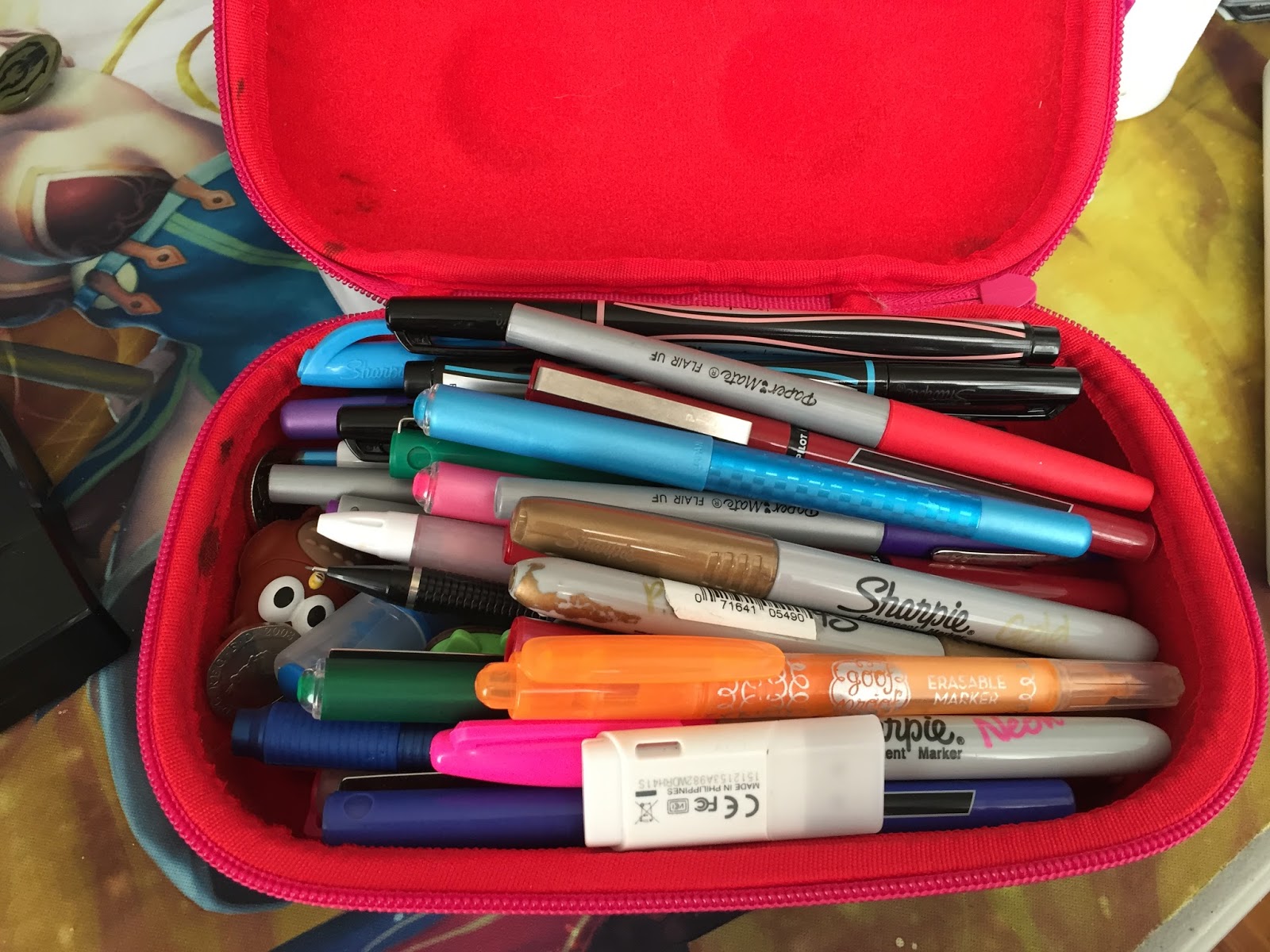
I have a pencil case that I take to events. In fact, I carry it pretty much everywhere I think I might want to do any sort of work. It looks like this:


Because, you know, I believe in fun.

1. Notebook

Everyone needs a notebook. Whether you're judging or on stage, having a place to write things down is super important. While a computer or smartphone can make a decent notebook, they have one huge downside: they need electricity. If your phone dies in the middle of the day, how are you going to write down the details of that sweet judge call you want to remember forever or the observation you made about the new judge's confidence?

My notebooks are also a record of the things I've accomplished and the things I still want to accomplish. They have notes from events, lists of posts I want to get around to writing, goals for judging and scorekeeping. It's a journal, but only for things related to Magic: the Gathering. I even have some pictures of sweet draft decks in there. This is one of the best tools that exists for reflection and improvement. Oh, and organization.

I like to use moleskine notebooks. They're expensive, but they hold up well to constant traveling and abuse. Plus, they come in a billion different colors, sizes and styles so I still get to have some fun with them. My current one is white. Well, it was white. It's gotten a little dirty.

2. Pens, Pencils, Highlighters, Sharpies

These take up most of the space in my pencil case. Surprising, right? I use pencil to fill in chart information that might change — starting table number and round, mostly. Highlighters are useful for processing drop sheets and prize payouts. Pens are for everything else.

I don't use sharpies much, but it's inevitable that I get asked for one at an event. Someone wants a card signed or a judge needs a bolder note on the pairings sheet. I always prefer to be the person that says "Yes, I can help you with that," so I bring a sharpie or two.

If you're judging, bring a red pen. Or pink. Or orange. Actually, anything that's not blue or black is just fine. Most players have blue and black pens, and anything that stands out on a match result slip is great. But please don't write on slips with sharpies. Especially not the back of slips. They bleed everywhere and make things hard to read.

3. Sticky Notes

There are a few things I'm miserable at remembering. Assigning fixed seats when I get registration files is probably the biggest one, so I write the player's name and table number on a sticky note and plant it firmly on my computer screen, usually somewhere where it's in the way. Sometimes it helps, and sometimes I get used to working around it and forget why it's there.

Sticky notes are also great for tagging lost and found items and passing notes. Most of the organizers I've worked with have these in their office supplies, but I always bring my own little ones.

4. Flash Drives

For the people on stage, the Internet is usually an essential tool. We use it to pass files around and communicate with staff on the other side of the hall. But, inevitably, something bad happens. Someone's laptop can't connect. We hit the maximum number of connections. It's too slow to sync files. A flash drive solves all of these problems.

I have an owl and a turtle. There's nothing like a small silver lining to a stressful situation, and absurd flash drives are amusing, right? I also have a grown-up flash drive for when I want people to think I'm a professional, but that's not very often.

5. USB Hub

Speaking of, I need to get a new one of these. My old one has outlived its functionality :(

Sometimes an organizer hands me a laptop, and sometimes I use my own. My laptop has three USB ports. I've been at many events where the admin laptops only had two. When you know you need to plug in a printer, a mouse and, often, a 10-key, two or three USB ports doesn't cut it, especially not when Internet access might use one and you might need to transfer files the old fashioned way.

6. Headphones

If there's any chance I'm interacting with players, my headphones stay in my pencil case. There are times when they're awesome, though, like catching up with paperwork as events are winding down, especially grinding through post-event entry of 8-man brackets, and on breaks. I use a hair tie or rubber band to keep them folded up nice and tidy.

7. Chargers

There's nothing quite like getting a quarter of the way through the day and realizing you don't have a phone, computer or tablet charger. Whoops. My computer charger doesn't fit neatly in my pencil case, but the other two do. Like headphones, I keep them wrapped up neatly with a hair tie. I also keep a backup computer charger in the backpack I travel with. I've never had to use it, but I'm glad it's there.

8. Change

This is one of the newest additions to my pencil case, mostly because I like Diet Coke WAY too much. Coins and $1 bills make it easier to acquire delicious beverages from vending machines. They also make it easier to make change for communal lunch orders and coffee/hot chocolate runs.

9. Advil

Advil is my headache-be-gone drug of choice. It's also awesome to have around when the venue chairs suck or I do something stupid to my shoulders or wrists while I'm working.

Many organizers can't provide ibuprofen or any other drugs to their staff or players, and working through pain is miserable. I've forgotten this a couple times, and all the other awesome registration and scorekeeping staff who don't forget have been responsible for my sanity at more than one event.

10. Tablet, Book or Other Entertainment

Taking breaks is important. I'm one of the worst offenders on this front — I enjoy scorekeeping, and I'd often rather keep doing it than go do something else, especially if exciting things are happening. I'm extra bad at taking breaks when I've been working on something with my downtime, like a blog post, review or event feedback.

Having something to do while on break makes leaving the stage and disconnecting from the event for a while more enticing.

What do you take to events? Whether you're judging, on stage or working in some other role, what things are essential to your event success?

(Edit: Thanks for the comments guys! They have to be approved before they appear to prevent spam, so if you don't see your comment right away it's because I haven't seen it yet.)