Monday, October 5, 2015

WER: Sealed PPTQ Top 8s

This past weekend, my area hosted two Sealed Preliminary Pro Tour Qualifiers to celebrate the release of Battle for Zendikar, and I also got a few messages from judges asking about the best way to handle their top 8 brackets in WER. There are two things that make this a little complicated:


  • WER won't let you make pods for non-draft events, and these events are Sealed.
  • WER defaults to pairing the top 8 by seed, which isn't any good for Sealed PPTQs. Whoops.
Given the problems that draft pods can cause with WER, it might not be a bad thing that you can't create a pod for these events ;)

Let me back up a little bit. If you're not familiar with the format guidelines for Sealed PPTQs, the top 8 draft portion isn't paired the same way as the top 8 of a constructed PPTQ. Instead, players are seated randomly around the draft table and then paired according to where they sat. The play-draw rule still applies as it would for a seeded bracket, using standing after the Swiss rounds.

Here's the draft seating chart from the MTR:

And here's the draft bracket from the MTR:


Note that in this bracket, the first seed isn't necessarily playing against the eighth seed. They could be playing anyone.

Randomizing Seating

There are a bunch of ways to randomize seating. You can use the seating function in WER and uncheck the seating by name box. You could also use dice, Magic cards with different converted mana costs, or any other randomization method. You do not, however, want to generate top 8 pairings and use those to determine seating, because these aren't random; they're based on Swiss standings.

Creating Pairings

The bracket above reflects the appropriate pairings. Here are some tricks to remembering how it works when the bracket and seating chart aren't available:

  • In the first round, each player plays against the player sitting farthest away from them.
  • A player can't play someone sitting next to them until the final round. They also can't play anyone who would have played someone sitting next to them until the final round. This means they'll be playing someone who was sitting two seats away.
WER won't create the correct pairings for the quarterfinals or the semifinals because it defaults to the seeded bracket pairings. You'll have to manually update the pairings to reflect the randomized draft bracket by using the Edit Matches screen.

Be extra careful with the semifinal pairings. WER will default to pairings that are based on Swiss standings if it can, and they're probably not correct. I recommend writing out a bracket like the one from the MTR, filling it in with the players' names, and entering the WER matches for the entire top 8 when the tournament is finished.

Monday, September 28, 2015

2015 Mid-Atlantic Judge Conference: Becoming a Better Teaching Judge by Erik Aliff

The Fall 2015 Mid-Atlantic Judge Conference is in the books. Ninety-three (ish?) levels of judges turned out to Battlegrounds, an LGS in Richmond, Virginia, to talk shop and teach each other new things. I had the pleasure of presenting on WER in the last time slot (and you can see the PowerPoint), but for the first three hours of the conference I had an even greater pleasure: learning new things from other judges.

The first presentation I attended was Erik Aliff's Becoming a Better Teaching Judge, about communication and how judges can use communication models to become better educators. Erik is a teacher IRL, and he brought his classroom experience to bear on the 20 (ish) of us who attended his presentation. That's one of my favorite things about judge conferences — each one of us has a life outside of judging, and brings valuable experience and expertise to share.


The image on Erik's PowerPoint, which you can almost make out in my amazing photo (*cough*) is a communication model diagram. It was the focus of his presentation. Here's the detail of the diagram:

But, before we get into too much detail on that, we should start at the beginning, with the first question Erik asked the audience. Why do we communicate?

There were a lot of answers.


  • Because I have something I need to tell you.
  • Because I want to express myself.
  • Because I want to indicate awareness of my triggers.
Yeah, that last one was way funnier in person. But, as Erik pointed out, all of these things are just really specific examples of the one reason we communicate.

We communicate because we want something.

We want players to know that pairings are going up, and we want our opponents to let us resolve our triggers. As judges, we are responsible for communicating an enormous amount of information during an event, and that communication is insanely complex.

We're speakers and listeners at the same time, and we need to be able to adapt to changing communication situations. Let's go back to the model and start at the beginning, with speakers and listeners.

Speakers

Speakers have a purpose. They want something. When we're judging our purpose is often to provide information. There are some purposes that we should discard. Showing off how well you (not we, because I definitely don't know them that well) know the comprehensive rules makes you look smart, but looking smart doesn't help the players enjoy their event.

I'm going to provide them with the best information, with the answer that they need. This has to be our purpose.

Speakers have knowledge. There are things that they know and don't know. The knowledge we have can be relevant, exciting, and meaningful, but it's important as a backdrop to all of our communication.

Speakers have attitudes about themselves, their listeners, and the conversation. A speaker's attitude about himself is important to how he's received by his listener. If he's confident, he'll be more credible than if he appears uncertain or nervous. A speaker's attitude toward his listener can change how he approaches the communication.

Keep in mind that, whether or not you like an individual player, your purpose should be to help them. Finally, speakers have attitudes about the conversation. If you don't want to be involved in the conversation, it will influence the effectiveness of your communication.

Listeners

Like speakers, listeners have a purpose, they have knowledge, and they have attitudes.

Determining whether what your listener--often a player or another judge--wants is the same as what he's saying his wants is important for communicating effectively. A common judging example of this are poorly phrased questions that require answers that may be misleading.

"Can I target that spell with Spellskite?" "Yes, you can." But, it might not do what you want it to do. Trying to understand the purpose of your listener. Ask questions until you're sure you understand what's going on and what your listener wants.

As judges, our job is often to fill the gap between a listener's prior knowledge and what we need them to know. Rules questions are an obvious example. Players have an understanding of the rules, but might not know how a specific interaction works.

We step in and fill the gap between their knowledge and what they need to continue playing their game. We also often fill the knowledge gap in regards to tournament operations: your parings are posted over there; there are 15 minutes left in the round; standings will be posted when the last result slip is in.

Listeners also have attitudes that can help or impede our attempt's to communicate with them. If they've had a bad experience with a judge before, they may be less trusting. If they're on tilt, they may be more confrontational toward their opponents or flustered with themselves.

Assessing their attitude about themselves, their situation and the other people involved can help you adjust your communication style to be more effective. Erik recommended taking the time when you're walking to the table to try to get an idea about the players' attitudes. What's their body language like? Is it open and friendly or closed and tense?


(Some judges listening to Jeph Foster and Eric Dustin Brown kick off the conference.)


Changing Purposes

Often, other people will attempt to change our purpose, to get us to want what they want. Is changing your purpose okay? Yes, absolutely. But whether or not you should change your purpose depends on the situation, your original purpose, and the knowledge and attitudes of both speakers and listeners.

Frame of Reference

In the model above, the white background can be viewed as the frame of reference. Everyone has different expectations and understandings when entering a conversation. Different cultures have different views on authority, for example, and that might change how you need to communicate to effectively convey your message.

People play Magic all around the globe. They come from different backgrounds and expect different things. It may be difficult to anticipate how someone is going to react to a situation, but trying to understand your listener's frame of reference will go a long way toward understanding what they want and how you can help them.

Verbal and Non-Verbal Communication

Yep, now we're at the arrows. Verbal communication is easy: it's the things we say and write. Okay, so maybe it's not so easy. Written words can be misinterpreted. Spoken words have the advantage of intonation, which helps us convey more meaning than the words themselves.

If verbal communication is tricky, nonverbal communication is another beast entirely. Our body language is something that we don't always control and we're often not aware of, but it's an important part of our message. It expresses our purpose, knowledge, and attitudes. Worse, it can sometimes work at cross purposes with our verbal communication. Practice awareness of your body language and whether it reinforces or impedes the message you're trying to convey.

Erik's example of this was with height differences. If you tower over players, you present yourself as intimidating, potentially as a superior or even an enemy. If you're on their level, however, you present yourself as an equal who's trying to help them solve their problem. Kneeling next to a table so that you're at eye level with the players can help to defuse tense situations or let them know that you're on their side, and the enemy is whatever problem they're experiencing in their match.

Channels

At events, the most common communication channel between players and judges is the spoken word. Whether it's over a PA system or face-to-face, much of the communication that goes on uses words, tones and body language.

Many, many, many other communication channels exist. Text messages. Email. Phone calls. Smoke signals. Choosing an appropriate channel is an important part of communicating an effective message. For judges, this is often relevant to providing feedback after an event.

Do you talk to other judges in person, send them a Facebook message, or just submit a Judge Center review? Keep in mind that nonverbal channels often make messages ambiguous. Emotions are added on top of words that you may or may not have intended.

Interference

Lots of things can get in the way of effective communication. A crackly PA system can make it impossible to understand announcements. Language barriers at large international events can make it difficult for players to communicate clearly with their opponents about what they're trying to do. Attitudes can get in the way of understanding a speaker's or listener's purpose. Fatigue can cause speakers to ramble when they think they're being clear.

Identifying sources of interference is the first step toward overcoming them. A crackly PA system is easy to spot. A player's bad experience with a judge at another event may be harder to ferret out, but addressing the issue directly may make them more confident in your rulings.

Feedback

Sometimes, feedback is direct and immediate. "I don't understand what you said," is a clear indication that you failed to communicate your meaning. Sometimes, however, that feedback isn't so clear. Body language, tone, and other nonverbal cues may be all we have to figure out that a player or other event staff member doesn't understand what we're saying.

In order to improve your communication, you need to assess it. If you think a player doesn't understand, ask a question like "Did that answer your question?" You can also get feedback from other judges who observed your interactions. Ask specific questions:

  • Was my meaning clear?
  • Do you think my body language reinforced what I was saying?
  • Do you think the players understand what's going on now?
As will all aspects of judging, seeking feedback is the key to improving.

Erik did something during his presentation that I can't do in text, which is a shame: he reinforced these parts of the communication model with real examples. He towered over one of the judges in the front row, then sat next to him to show how much of a drastic difference body language can make in communication. He gave examples of how different tones can change the meaning of otherwise identical statements. He put up an image of crying babies and explained that, yes, judge sometimes do communicate like that--without making their purpose or message clear.

Here's a link to a collection of communication resources, most of them TED talks. Hopefully they, and the information from Erik's seminar, help you Become a Better Teaching Judge.


Thursday, September 17, 2015

Comprehensive(ish) Guide to Match Result Slips

The life of a scorekeeper revolves around match result slips. Most of the time (unless something has gone wrong, we're hungry, or we drank too much Diet Coke last round) we're sitting on stage pressing buttons on a computer and hoping nothing breaks.

Slips are our connection to the tournament and its players. Through them, we get the information we need to keep the event moving. In the ideal and perfect scorekeeping world, they're cut perfectly, filled out neatly, and don't have any water/soda/blood/I don't really want to know what else on them. (Yes, all of those things have happened.)

The ideal and perfect scorekeeping world doesn't exist, but I am dedicated to bringing it one step closer to reality. Take note of these things for your next large event, share them with your Paper Team, and make a scorekeeper near you very happy. Or at least a bit happier.

Cut

Cutting match result slips well is super important. A slip that looks like this one will make any scorekeeper's life really difficult:


Yep. That was turned in at real event. Table number, player names, and results are essential pieces of information on slips. I managed to figure this one out with a bit of detective work, but it took some time. When I'm scorekeeping, time is the most precious commodity, and it's much easier to deal with slips that are cut neatly:

  • Top and bottom of the sheet are cut off. This might not seem important, but ask the scorekeeper at your next event if you can help sort slips and you'll see why it is.
  • Try to cut on the line. It doesn't have to be perfect. The important parts are that the slips are the same size and all the pertinent information is there.
  • Edges are neat. Slips tend to stick together when they're not. To keep the paper cutter from pulling, press the blade in while you push down. I was *miserable* at cutting paper until someone taught me this.
  • If you mess up cutting slips, let me know and ask me to print more, especially if the event is using DCI-R -- I can re-print a specific range of slips.

As a corollary, please don't fold/crumple/tear/nibble on/completely devour match result slips.

There are some questions for which there are two kinds of answers: answers that are okay and answers that are completely gross. I avoid asking those questions as much as possible because I don't want to know any answer in the second category. "Why is this match result slip wet?" is one of those questions.

Penalties

Penalties should be written out like this, legibly, on the back of match result slips:

[Judge Name First, Last] [Player Name Last, First] [Infraction] [Penalty] [Concise Description]

Some scorekeepers like a different order for judge and player name, and if your scorekeeper, team lead, or head judge tells you to write penalties differently, by all means do.

Most scorekeepers are familiar with the IPG, either as judges themselves or by virtue of having typed a million or so penalties. As such, you can save yourself some time when writing penalties with some abbreviations.

Infractions

IPD@SoG (or similar): Improper Draw at Start of Game
LEC/L@EC: Looking at Extra Cards
GRV/GRE: Game Rule Violation/Error
FTMGS: Failure to Maintain Game State
DEC: Drawing Extra Cards
MT: Missed Trigger
DDLP: Deck/Decklist Problem

Penalties

W: Warning
GL: Game Loss
ML: Match Loss

If the penalty that was issued is the standard penalty for that infraction, it's not really necessary to write it down. If there was an upgrade or downgrade, it's essential that it's written down, and maybe circled so the scorekeeper doesn't overlook it.

Concise Description

This part is important. The fewer words you write, the fewer I have to parse and type, but it has to be long enough to sufficiently convey what happened in the match. If it's an infraction that occurs regularly, like drawing seven cards on a mulligan, using "shorthand" is a quick, easy way to convey what happened.

Here are some of the phrases I like to use:
  • Mulliganed to 7
  • Flipped top card
  • 59/15
  • See above (for Failure to Maintain Game State, when the GRV is already described)
If there are details that you think are important to the situation, like something you observed that might raise a red flag, write it down on the slip. Make sure you use specific details about what happened rather than your thoughts on it -- players can flip over the slip and read the penalty any time.

And on that note, make sure what you write down doesn't give any information away to the players.


Okay, so my handwriting there wasn't the neatest, but it's legible! (I think.)

No Shows

There's an easy way to fill out no shows, and there's a hard way. The hard way involves writing anything on the back of a match result slips. The easy way ends up looking like this:


There's not really much to say about no-show penalties, and filling out the slip like this tells the scorekeeper everything they need to know.

Notice that the game record isn't in pen -- that's because the player who did show up to the match filled it out instead of me (or they would have, if this wasn't just a mock slip).

That's important enough that I'll say it again, in bold, and centered:

Always have the player at the table fill out no show results.

Players know who they are, and they know that they're the one winning this match. Whether you hear their name and are thinking about which player to assign the penalty to or the players have similar names, the result is rather frequently the same: the wrong player getting assigned the penalty and dropped.

If you have the player fill out the 0-2 or 2-0 and sign before you make a mark, the odds of that are dramatically reduced. Accidentally dropped players are the most tedious scorekeeping issue to fix (apart from things completely exploding, that is), and many times they can be avoided with this simple measure.

Things to Confirm

Weird things happen on slips all the time. Players start to fill them out wrong. They decide they don't want to drop after all. Almost all the time, completely scribbling through the mistake and re-writing it is a perfectly clear indication of what the slip is supposed to say.

Initialling the slip in red ink lets the scorekeeper know that a judge was involved and everything's correct -- if I have a question about a slip, I'll track down the judge whose initials are on it, or the players.

Here are some cases where a little extra confirmation helps:

  • If a player accidentally marked the drop column, write "NOT DROPPING" somewhere next to the scribble. Sometimes players scribble in that column to indicate that they want to drop, and I don't want to guess wrong.
  • If the winner of a match is dropping, judge initials help me confirm that the drop mark is next to the correct player's name.
  • During end-of-round procedures, put a 0 in the draws column if a match ended 1-1.

If a player forgot to sign the slip and you still can't find them, still turn the slip in. Having a result for the match is better than having a slip floating around on the floor. If there's an error in the result, innocent or otherwise, it can be corrected at the beginning of the next round, and that's better than the potential delay caused to the entire event. Players signing on the wrong line, on the other hand, isn't a problem at all.

Do you have any other tips and tricks for match result slips? Let us know :D

Thursday, September 10, 2015

GP Charlotte 2015: How to Help Your Swiss Sides Scorekeeper

Yep, you read that title correctly. Grand Prix Charlotte was a few months ago, but I'm behind on my event posts and some interesting things happened, so here we are :) I enjoy writing things down (could you tell?), and I'm a bit of pack rat, so my notes from this GP are stored right between my notes from GP Vegas and the SCG Open in Baltimore that happened at the end of June. Yay!

Charlotte as an event city holds a special place in my heart: I attended my first GP there a few years ago, when the nearly 2700 main event players blew old attendance records out of the water. Yep. First GP ever. As a player, as a judge, or as stage staff. Man, that event was real. Anyway. Back to the present. Well, closer to the present at least.

Infinite Challenge Badges

The big news from the most recent GP Charlotte was the debut of StarCityGames.com's Infinite Challenge Badge. A single fee for the weekend got a player entry into any of the Challenge Swiss side events, which were my domain for the weekend. Here's a pic from my notebook to give you a rough idea of how many events that was:


Of the events on that list, only the Friday Foiled Again event wasn't part of the Infinite Challenge Badge. It's a little hard to see in the picture, but if you look under players for the Sealed events on Saturday and Sunday, you might be able to make out my notes about how many drops there were before round 1 of those events — about half of the total number of entries.

Turns out, when you tell players they can sign up for Sealed events for free as part of their Infinite Challenge Badge, they do it, take the packs, and drop. But, we have to have some record of them to help with product reconciliation at the end of the event and to track how well the Challenge Badges are doing. So, they had to be registered, and dropped.

Figuring out which half of a 300-person event doesn't want to play round 1 can be challenging (heh), and any method is bound to introduce some amount of error. This is what I did:

1. Printed an extra copy of the seatings by name that went up for deck building.
2. Asked the Head Judge of the event to announce that any players wanting to drop should remain in their seats until a judge comes by and gets their name.
3. Asked a judge or two to work through the seated players and highlight the names of those who wanted to drop, then bring me the list as soon as possible.
4. Traded a blank sheet of paper for that list as soon as it was done so players could drop from the build area, and I'd have a more condensed list to work from after I got through the highlighted names on the seating.
5. Asked a judge to stand in front of my computer and help players who didn't need my help specifically.

The process was time consuming for each event, but it worked. Players were dropped before it was time to pair the first round. A few players were dropped accidentally because they weren't in their seats when the judge with the list got to them, but that's pretty easy to fix.

The Challenge Badges posed a few other problems for the event, but most of them were beyond the scope of my scorekeeping assignment:

  • People were trying to sign up for events with their friend's badges.
  • The Badge line got lengthy, and some players had trouble picking up their badges and registering for events in time.
  • Players with Badges tended to try to register for events after the cutoff times.
The awesome registration and admin staff dealt with these issues as well as they could, and overall I think the Badges were successful. I also think they do something kind of important for Grand Prix events:

They make Grand Prix less about a single tournament and more about the festival atmosphere that comes with hanging out with your friends and playing Magic: the Gathering.

That's a pretty big shift from the mentality that's existed around GPs until now, and I'm excited about it. The way the Vegas 2015 venue was set up contributed to that convention feel — vendors and artists making the giant room seem smaller, lots of things going on — and I'm all for the community aspects of Magic over the competitive, tournament-winning aspects. Winning tournaments is fun, but so is making memories.

Judging Swiss Sides

Back to my title (How to Help Your Swiss Sides Scorekeeper): scorekeeping Swiss sides at GPs can be grueling. An event is firing every hour, rounds flip at around the same time, and there tend to be lots of people looking for lots of different kinds of information. Staying organized is critical, or answering questions takes longer. If answering questions takes longer, performing tasks gets delayed, and delays spiral into ... bad things.

There are many items on my list of things Swiss judges can do for their scorekeeper at large events, like volunteering to make a Starbucks run for hot chocolate, but these are the most important ones:

If you're Head Judging a Swiss event, let me know your starting table number as soon as possible.

As soon as possible means as soon as the previous event is seated and you know what tables will be free. If there are factors beyond your control preventing you from figuring out your starting table number, like On-Demand events or a table shift of the main event, let me know. If I can't help you figure it out, at least I know when to expect the information to be available. Setting high table numbers in DCI-R can take a bit of work, and the more warning I have the faster I can get the tournament started when registration closes.

Don't ask me how many players are in the event until about 10 minutes before it starts.

Chances are good that I have no idea. I don't usually get player files from registration until registration closes, which is at about the ten-till mark. If something crazy is happening at registration, like a massive line, I might not know until ten minutes after the event is supposed to start.

If you need this information for your starting table number — for example, if you know what you want your ending table number to be — or to prepare extra sealed product, please let me know instead of taking "I don't know" as answer. I can figure out the starting table number when registration closes, or try to get you the information you need.

Leave me your name, DCI number, and the name of the event you're judging, preferably in a tangible, papery form. If you go on break, tell me who's replacing you and when you'll be back.

I, personally, am notoriously bad at remembering to add judges to events. If you put this information in front of me, I'm more likely to remember. I want you to get credit for judging this event, but when things get hectic that's one of the first tasks to get back burnered. Also, feel free to remind me when things are quiet. Tracking you down later is a pain, and I'd rather get you in the file while your event is active.

Plus, if I need to find you for something it's much easier for me to ask for you by name than "whoever the Head Judge of the 5 p.m. Modern Challenge is."

Remember to make special announcements.

Some of the things scorekeepers ask you to remind players about — to take their fourth round result slips to customer service at SCG GPs — may seem inconsequential, but they're not. If you don't make these announcements, I have to answer "Where do I get my prizes?" for every player in the event, which takes time. Some players won't listen no matter how many announcements you make or signs you post, that's inevitable, but heading off as many of the questions as possible is a huge help.

Ask for the things you need.

I'm here, first and foremost, to facilitate the event that you're judging. If there's something you need that you don't have, and you think I can help you, please ask. When you ask, help me help you:

  • Tell me what you need.
  • Tell me why you need it.
  • Tell me when you need it by.
That second question is important because I may be able to give you something that's more helpful than what you're asking for, or offer an alternative for what you're trying to accomplish. If you ask for a player list, I'll want to know if you're using it for drops or deck checks because there are different kinds of printouts that better suited to each of those tasks.

The third question is important because I'm probably busy. If you need that thing right away, let me know so that I can make it a higher priority. If it can wait ten minutes or until after the next round starts, tell me that too. If it can wait, and I forget to do it, ask again. I'm human. I can juggle lots of different things, and I'm pretty good at remembering what people have asked for, but I'm not perfect.

Also, hot chocolate.

Not really. But if you keep these things in mind when you're working Swiss side events, your scorekeeper will thank you. At least I will. Most of the time.

Mid-Atlantic Judge Conference

The Mid-Atlantic region is having a judge conference next Sunday! (That's September 20th, 2015.) I've put together a presentation on WER topics for attendees that I'll make public, in the form of a PowerPoint, some notes, and some blog posts in the week or so after the conference. If there are specific questions you have about WER for your local store's FNMs, GPTs, and PPTQs, let me know! I'll try to incorporate suggestions into the presentation, and I'm always happy to try to answer questions directly.

Additionally, I'm going to spend the three presentation blocks I'm not presenting doing some (probably awful) coverage of the other presentations. I hope to wrangle some of the other awesome attendees to help my efforts, so look out for that: D

(I promise those posts will have more pictures than this one.)

Friday, August 21, 2015

WER: Handling Prizes and Standings Exports

While handing out prizes isn't strictly a scorekeeper operation, it's something that they (and judges) are often called on to do at events from Friday Night Magic to SCG Opens. Speeding this process up makes everyone happier -- less standing in line, more cracking packs or spending store credit -- and having a set method going in not only makes it faster, it also helps with your organization and reconciliation.

My favorite method applies to events with a prize structure based on players' final records, and might just be useful for you tonight at Friday Night Magic.

If you're giving out prizes based on standings instead of match points, you have to wait until the last round is over before you can do much of anything; otherwise, you can start giving out prizes as soon as the last round starts.

For a four-round Swiss event, you'll also need a printed copy of standings after Round 3. The Standings tab in WER (pictured below) does update in real time as results are entered, but that doesn't help you keep track of which players have reported their final-round matches and which ones have received prizes. You also can't write on it.

Well, I mean, you can. But your Tournament Organizer might be a little upset by that.

(DCI Numbers removed to protect the innocent.)

Update the points on your printed copy of standings as results are reported and give players the prizes that correspond to their new record.. Personally, I use these marks because they're simple and clean:

  • Loss: circle the player's match points
  • Win: Single diagonal line through their old match points, write in the new total next to it.
  • Prizes: Highlight or cross out the names of players that have received prizes and make a note of prize options (set, store credit alternative, etc.)

I also like using the standings sheet to note things like which players are getting random FNM foils or other door prizes so I can hand them out with the prizes for top finishers.

You can enter results after everyone has prized out, or as the round progresses. Doing it later frees up your time a bit, which can be helpful if you're at Friday Night Magic and juggling Standard and Modern events or helping out with the register. Just make sure you get them in, and get the event uploaded, before the night is over so everyone gets their Planeswalker Points.

Scaling

My other favorite thing about this method is that is scales well to any size event. It works equally well for my 8-player mock event as it does for the 300-player Challenges we ran in GP London last weekend. Scaling up to *that* many players requires modifying the system slightly so that multiple people can access the third round standings and record new information.

There are a few ways to do this.

First, split the physical pages of standings into different stations. You can divide stations by record going into Round 4 or by last name by taking advantage of the ability to print Standings by Rank or Standings by Name.

If you have a computer for everyone helping with prizes, you can also use Google Docs (which might be the greatest thing ever for event operations). Getting the standings information into spreadsheet format requires a little bit of work.

Exporting Standings to Excel

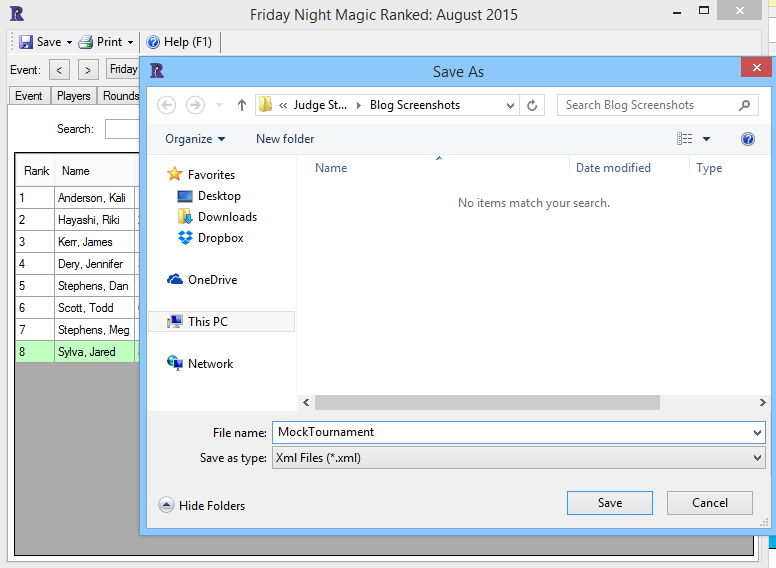
To start, navigate to the Standings tab and click "Export Standings" (see image above). Enter a unique file name. Using the tournament type, date, and round works well. I called this one MockTournament because...it is :D


The standings export is an XML file, which looks gross and isn't particularly useful. Change the file extension* to an Excel extension, like .xls. You can do this by renaming the file if you have file extensions shown in your folders (which I highly recommend). Your computer will warn you that changing file extensions can do Bad Things to files. Click "OK", then open the file from the folder where you saved it.

You'll see a few more prompts of the "hey, you're doing weird things with this file" variety. Click "Yes" for the first one. Leave "As an XML table" selected for the second one, and click "OK."


Wait. You're not done yet. There's one more. Just click "OK" on the third pop-up, and you'll get a very pretty spreadsheet:

(DCI Numbers removed to protect the innocent.)

Now that you know how to create them, having standings in Excel is also useful for things other than just prizes:

  • Monthly Friday Night Magic leaderboards
  • Magic League point tracking
  • Formating standings to post online

Enjoy your FNMs :)